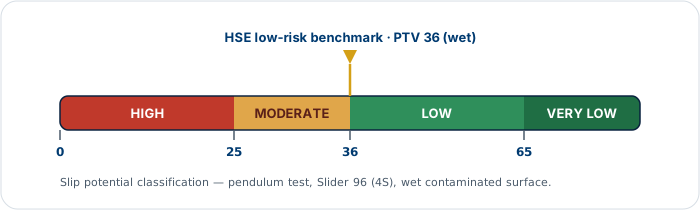
The pendulum test, and what a PTV tells you.
The pendulum (or "TRL pendulum") is a portable instrument that swings a weighted arm carrying a rubber slider across the floor. The friction the floor offers slows the swing, and that loss of momentum is read off the dial as a Pendulum Test Value (PTV) — the higher the number, the more grip the floor provides.
Why the pendulum
It is the method named in BS 7976-2 and BS EN 16165, and the one the HSE identifies as its preferred test for both new floors and post-accident investigation. Because it reproduces the way a heel strikes the floor, it reflects real slipping far better than a quick "feels grippy" judgement.
Wet, dry and in three directions
We test each area in three directions and, crucially, in the wet — because that is when floors become dangerous. Results are recorded along, across and diagonally to the main line of travel to account for directional texture and wear.
Two slider rubbers
For ordinary shod areas we use the Slider 96 (4S) rubber; for barefoot areas such as pool surrounds and changing rooms we use the Slider 55. Both may be used on profiled or textured surfaces.
Surface microroughness
Where it adds confidence, we can also measure the floor's surface microroughness (in microns), which the HSE recognises as a useful companion measurement to the pendulum, particularly on surfaces wetted with water.